
When it comes to POCs, one of the more interesting presentations at the WAN Summit was given by Snehal Patel, network architect, at the Gap. The Gap, if you don’t know, has been sort of the poster child for Viptela’s SD-WAN. And while the needs of the Gap may not necessarily align with every small- to medium-sized enterprise, Patel does a good job providing a sort of “man on the ground” look at what’s happening with SD-WANs and how their POC worked.
 that prevents SD-WAN vendors from scoring well by dominating any one use case. Identify the use cases that are important to your organization and group them by area. Maybe ease of deployment and configuration are particularly important for your end nodes. You’re use cases might be zero-touch deployment, policy configuration and the like. Once you have your use cases grouped appropriately, weight them in their relative importance. If Zero Touch Deployment most important, give it a 5. If policy is less important give it a 1. Only then grade vendors across each use case with the final score being the weighted result.
As for purchase criteria, The Gap was looking to eliminate their underlying investment in routing. They wanted a policy-driven SD-WAN with a full routing stack (BGP and OSPF) and that could scale.
Encryption should be IKE-less and with every location connected to multiple Internet paths, active-active with performance visibility was very important.
Like many large organization, The Gap has learned about the importance of segmenting their backbones. The company wanted network segmentation with an L3VPN. Stores are widely distributed with little onsite expertise so Zero Touch Provisioning (ZTP) was important. With operations being done remotely, you’re looking at the need for easy code upgrade, circuit statistic and usage, centralized templates for configuration and centralized policies.
that prevents SD-WAN vendors from scoring well by dominating any one use case. Identify the use cases that are important to your organization and group them by area. Maybe ease of deployment and configuration are particularly important for your end nodes. You’re use cases might be zero-touch deployment, policy configuration and the like. Once you have your use cases grouped appropriately, weight them in their relative importance. If Zero Touch Deployment most important, give it a 5. If policy is less important give it a 1. Only then grade vendors across each use case with the final score being the weighted result.
As for purchase criteria, The Gap was looking to eliminate their underlying investment in routing. They wanted a policy-driven SD-WAN with a full routing stack (BGP and OSPF) and that could scale.
Encryption should be IKE-less and with every location connected to multiple Internet paths, active-active with performance visibility was very important.
Like many large organization, The Gap has learned about the importance of segmenting their backbones. The company wanted network segmentation with an L3VPN. Stores are widely distributed with little onsite expertise so Zero Touch Provisioning (ZTP) was important. With operations being done remotely, you’re looking at the need for easy code upgrade, circuit statistic and usage, centralized templates for configuration and centralized policies.
Conducting a Proof of Concept (POC)
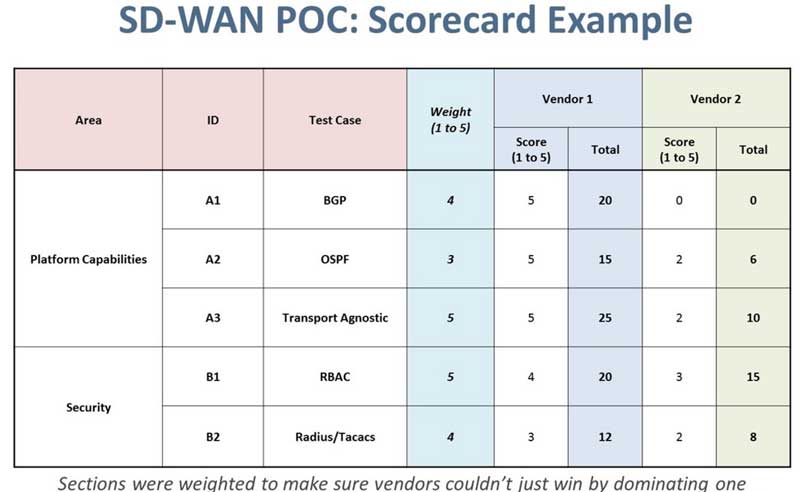
I won’t walk through the Gap case study in detail, but there were a few concrete takeaways that I thought were helpful. At a very practical level, if you’re looking to conduct a POC consider constructing a scorecardthat prevents SD-WAN vendors from scoring well by dominating any one use case. Identify the use cases that are important to your organization and group them by area. Maybe ease of deployment and configuration are particularly important for your end nodes. You’re use cases might be zero-touch deployment, policy configuration and the like. Once you have your use cases grouped appropriately, weight them in their relative importance. If Zero Touch Deployment most important, give it a 5. If policy is less important give it a 1. Only then grade vendors across each use case with the final score being the weighted result.
As for purchase criteria, The Gap was looking to eliminate their underlying investment in routing. They wanted a policy-driven SD-WAN with a full routing stack (BGP and OSPF) and that could scale.
Encryption should be IKE-less and with every location connected to multiple Internet paths, active-active with performance visibility was very important.
Like many large organization, The Gap has learned about the importance of segmenting their backbones. The company wanted network segmentation with an L3VPN. Stores are widely distributed with little onsite expertise so Zero Touch Provisioning (ZTP) was important. With operations being done remotely, you’re looking at the need for easy code upgrade, circuit statistic and usage, centralized templates for configuration and centralized policies.